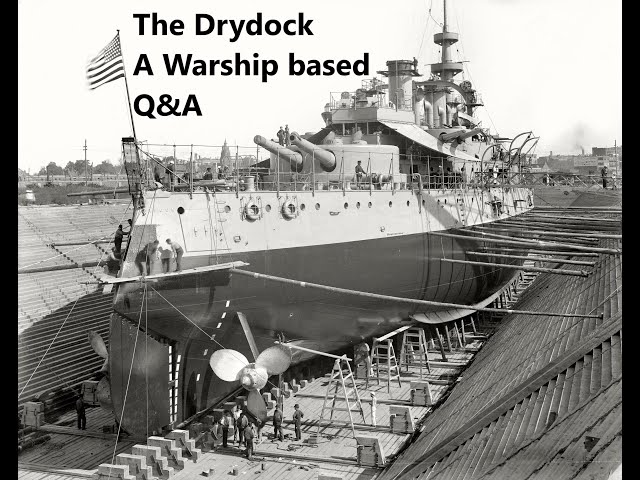
— Intro
— Early submarines used either petrol or kerosene powered engines, what were the benefits to using these types vs a diesel engine if any?
— U-boats are often used in an offensive position like hunting convoys or capital ships, but what about in a defensive position?
— Why did Japans Jeune Ecole style fleet have so much trouble with the obsolete Chinese ironclads?
— How many of the pre-1894 Majestic era ironclad oddities survived long enough to be scrapped during Fisher’s housecleaning of Victorian leftovers?
— Why the Royal Navy tradition of naming ships «Temeraire», when it’s entirely a French word? Was the original Temeraire just so good, that it became a core part of Royal Navy tradition?
— How are depth charge throwers such as k and Y guns reloaded at sea? Also, how are additional depth charges added to the roller racks during a fight? Is it just muscle power of the crew?
— How did the U-Boats deal with salt water corrosion of deck guns?
— Would it be possible to build certain battleship types much earlier?
— How were local transfers (between islands) handled by the US in WWII?
— Why were the Unryu’s a different class?
— Are there any sketch designs or blueprints that show what the Montanas would’ve looked like if the true specs of Yamato were known?
— Japanese flare drops for night attacks
— Where were the main hunting grounds of American and French Privateers during the American Revolution? For the Americans, did they change as the war went on?
— The Convair Sea Dart and hydroski fighters?
— Fleet Admiral William Leahy?
— Do you think the tender Akitsushima was effective with only 1 flying boat as her entire air complement?
Комментарии пользователей:
@indplt1595: Fleet Admiral Leahy was considerably more important than most historians consider, as the only in-depth book written about Leahy's life and outsized influence since Leahy published his understated memoir in 1950 was by Phillips Payson O'Brien, Professor of Strategic Studies at the University of St. Andrews in 2019.O'Brien began an in-depth study of the interplay between President Franklin D. Roosevelt and the U.S. military in How the War Was Won: Air-Sea Power and Allied Victory in World War II, published in 2015 when O'Brien noticed that FDR essentially acted as a unitary executive during the Second World War. O'Brien argues that it was because of Admiral Leahy, who had developed a close relationship with FDR streching back to the future president's tenure as Undersecretary of the Navy during Wilson's presidency from 1913-21, that FDR could consolidate power safe in the knowledge that, after conferring with his Chief of Staff and Chairman of the Joint Chiefs to craft the president's desired policy, that Leahy would implement FDR's policy to the letter.Roosevelt's long history with both the Navy and Leahy since 1913 manifested itself in a Navy-heavy policy culminating in the fact that General George Marshall envisioned fielding an army numbering in excess of 250 divisions but had to settle for 90 while Leahy directed the policy that ordered and began construction on over 100 escort carriers, 32 Essex-class fleet carriers and six Midway-class carriers along with the planes to fill them and the escorting warships to screen them at the expense of the firepower Marshall and Arnold desired to put on the European Theater of Operations. Leahy's outsized influence with both FDR and Truman (Leahy retained his position as Chief of Staff and Chairman of the Joint Chiefs until 1949) was so great O'Brien titled his 2019 study on Admiral Leahy The Second Most Powerful Man in the World: The Life of Admiral William D. Leahy, Roosevelt's Chief of Staff. If Roosevelt had gotten his way in 1944, it would have been abundantly obvious that Leahy wasn't merely the highest-ranking active-duty American military officer during WWII (General of the Armies John J. Pershing lived until 1948 and outranked all of the five star officers):"In early January 1944, an increasingly weak President Franklin Roosevelt turned to William Leahy in the White House and told his longtime friend that he wanted to make Leahy, since 1942 the president’s chief of staff, America’s only serving five-star military officer. FDR said nothing about promoting Army Chief of Staff George Marshall, Chief of Naval Operations Ernest King, or General of the Air Force Henry Arnold, but Leahy was adamant that the other Joint Chiefs of Staff be advanced as well, and the president relented. Leahy quickly moved on Roosevelt’s plan, meeting with Representative Carl Vinson (D-Georgia), chairman of the House Naval Affairs Committee and a longtime Leahy friend. The plan entered the congressional pipeline." also raises the curious point that other historians still assert the U.S. adopted a "Germany First" policy in December 1941 when American fighting men and material were sent to the Pacific in 1942 in such numbers the policy was decidedly "Japan First" until Operation Torch, and American policy morphed into prosecuting the wars against Europe and Japan with equal ferocity thereafter. O'Brien directly credits Admiral Leahy with this evolution, as the Joint Chiefs of Staff were a swirling mess of recrimination until Leahy returned from Vichy France, to use his "simple sailor" character to direct the top brass to FDR and Leahy's desired policy.Perhaps Professor O'Brien would jump at the opportunity to explain his Air-Sea Super Battlefield theory and Leahy's influence over American policy and strategy…though his theory of Japan First seems a little thin when in effect the ETO was run by the War Department and the PTO was the province of the Navy Department. The U.S. Army even created Army Service Forces to handle logistics in the ETO, mirroring Nimitz's Service Squadrons in the Pacific, without which American operations would have failed completely even if the U.S. had focused everything on the ETO first.But this went beyond logistics. General Marshall almost entirely kept the Marine Corps out of North African and European operations despite the USMC having trained incessantly for 25 years to conduct amphibious operations, and near-disasters in Italian amphibious assaults showed the U.S. Army was suffering steep learning curves while the Marines showed their expertise in the first month they went on the offensive in the Battle of Alligator Creek. The same occured in the Pacific until November 1942. U.S. Army ground forces were almost entirely absent in the PTO until after Operation Torch, with MacArthur's forces being largely Australian and Halsey's being USMC and USN, and even after GIs began to arrive in the South Pacific Marshall had neglected to send a seasoned flag officer to command them. Rather it took Hap Arnold's point man in the Pacific, USAAF Lt. General Millard Fillmore "Miff" Harmon to take command of all Army forces and work hand-in-glove with his superior, Admiral Halsey. This remarkable camaraderie even extended into the next-door theater, as Douglas MacArthur had taken a shine to the SOUTHPAC commander, Halsey.Meanwhile the U.S. Army was a hotbed of political intrigue, not only from SACEUR and future president Eisenhower, but MacArthur was potentially going to pull a McClellan in 1944 if the proma donna wasn't tasked with the ulimate mission of retaking the Philippines. This alternatively could explain why FDR essentially made Admiral Leahy acting commander-in-chief as the president was dying in 1944 and 1945. A consummate operator with no higher ambition that serving as POTUS's right-hand-man, O'Brien convincingly argues Leahy continued to implement FDR's policy after the president's health failed and ensured a smooth transiton to Truman, who unfortunately was a little too enamored with General Marshall.
@erikvandootingh7402: Regarding 42:06 on Japanese use of flares — another book that addresses the Battle of Rennell Island is "Blazing Star, Setting Sun" by Jeffrey Cox. In this author's description of the battle, green float flares were dropped to starboard and red ones to port, apparently marking the path of the US ships like navigational lights. Plain white floats flares were apparently used to mark direction as a line later appeared across the path of the ships to point the way back to base for the Japanese planes. The source cited for this particular passage is "La Vallette Rennell Island Report 3", though there are many others in the bibliography covering this battle as well.
@davidmcintyre8145: when talking of the Montanas'or indeed any of the later battleships it must be remembered that not only was tallboy in production as was Grand Slam the RN at least had an AP 2000lb bomb that in post war tests could go right through a Nelson or even a KGV from the weather deck to below the keel as well as B-bomb where it was understood that even a 250 lb B-bomb could cripple or sink any ship and B-bomb was planned in flavours up to 2000lb and finally there was highball. Then of course magnetic and other influence torpedoes had been immeasurably improved meaning that"one torpedo one ship"the fampous dictum of Otto Kretschmer was increasingly a reality
@t5ruxlee210: Creating lamp oil from crude oil was necessary once the whale oil sources for lighting were greatly diminished. "Petrol" at the time was a near worthless byproduct which came out of the refining equipment spout at a lower temperature before the desired, valuable, "Kerosene" showed up. That was the reason why petrol as a fuel was such a major attraction for inventors trying to get an ICE motor perfected to run on it. People were literally being paid to haul the explosive stuff away, no questions asked. Its only retail glimmer of hope at the time was as a dry cleaning liquid for home use sold in small amounts by some pharmacies.
@toddwebb7521: As far as a type that could have been built earlier, other than the fact there wasn't anything that needed that big of a response there's no real reason someone couldn't have built a ship similar to Orion/Bretagne/New York at around the same time as dreadnought. There was certainly liners and stuff bigger it's not like you couldn't make a power plant that big and 13.5 and larger guns had already been a thing in the ironclad era, they just chose to gu up in number of 12 in turrets in a gradual expansion instead of going straight there for practical and logistical reasons